


Every year, our production lines ship thousands of cotton promotional t-shirts to buyers across the United States USITC online HTS search tool 1. The question that comes up in almost every pricing conversation is the same: how much will duties add to my landed cost? It is a fair question — and the answer is more layered than most importers expect.
Cotton promotional t-shirts imported from China into the United States typically face a combined duty rate that includes a base MFN tariff of roughly 16.5% under HTS heading 6109.10, plus additional Section 301 or IEEPA surcharges that can push the total to approximately 47.7% of customs value as of 2025.
That number surprises many first-time importers binding ruling from CBP 2. The truth is, U.S. apparel duties are not a single flat tax. They stack. And the final rate depends on your product's exact classification, its declared customs value, and whichever China-specific trade measures are active on the day your shipment clears the port. Below, we break down every layer so you can budget accurately and avoid costly surprises.
How do I find the correct HTS code and base duty rate for my cotton t-shirts?
When we prepare commercial invoices for U.S.-bound shipments, the HTS code is the first detail our compliance team locks down. A wrong code does not just mean the wrong duty — it can trigger penalties and delays at the port.
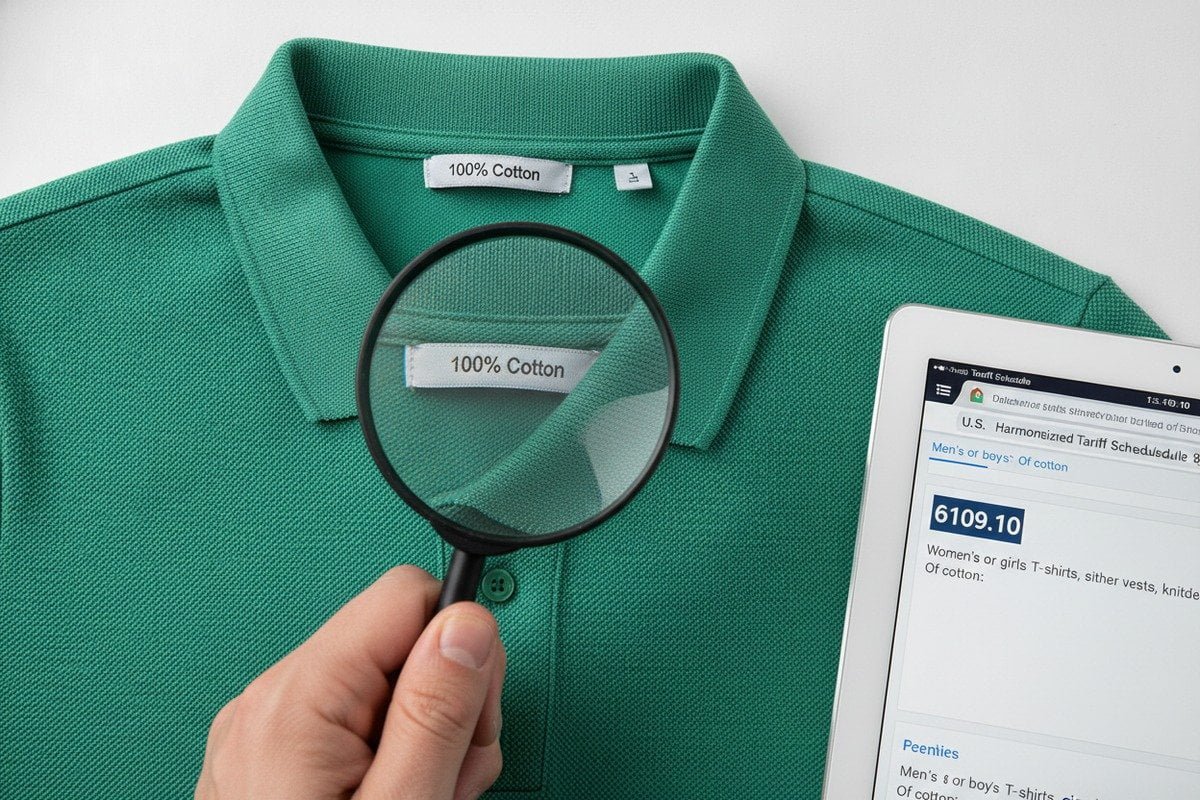
To find the correct HTS code, look up your cotton t-shirt under heading 6109.10 in the U.S. Harmonized Tariff Schedule. The exact 8- or 10-digit subheading depends on fiber content, garment construction, and whether the shirt is for men, women, or children. The base MFN duty for most cotton knit t-shirts is approximately 16.5%.
Why "Promotional T-Shirt" Is Not a Customs Term
U.S. Customs and Border Protection 3 does not care whether your t-shirt is a promotional giveaway, a retail product, or an employee uniform. What matters is the physical product. Customs officers classify goods by fiber content, knit or woven construction, garment type, and sometimes gender or size category. So a "promotional cotton tee" and a "retail cotton tee" made from the same fabric, with the same construction, receive the same HTS code and the same duty rate.
Breaking Down HTS 6109.10
HTS heading 6109 covers t-shirts, singlets, tank tops, and similar garments that are knitted or crocheted. The subheading 6109.10 narrows it to cotton. But there are further digits that matter.
| HTS Subheading | Description | Approximate Base Duty |
|---|---|---|
| 6109.10.0004 | Men's or boys' cotton t-shirts, knit | ~16.5% |
| 6109.10.0012 | Women's or girls' cotton t-shirts, knit | ~16.5% |
| 6109.10.0027 | Other cotton t-shirts, knit (including unisex/kids) | ~16.5% |
The rates above are the column 1, general (MFN) rates. They apply to most trading partners, including China, before any additional tariffs are layered on.
How to Verify the Code Before You Ship
- Use the USITC online HTS search tool. Go to hts.usitc.gov and type "6109.10" or search "cotton t-shirt."
- Cross-check with your customs broker. A licensed broker can issue a pre-classification opinion.
- Request a binding ruling from CBP. If the value of your shipment is large, a binding ruling gives you legal certainty.
From our side, we include the suggested HTS code on every proforma invoice. But the legal responsibility for correct classification rests with the importer of record 4 — that is you, the U.S. buyer.
Fiber Content Matters More Than You Think
A t-shirt labeled "cotton" may contain a small percentage of polyester or spandex for stretch. If the cotton content drops below 50%, the garment may fall under a different HTS heading entirely, such as 6109.90 for t-shirts of other textile materials. That heading carries a different duty rate. Always confirm the actual fiber breakdown with your supplier before classifying.
Will I have to pay additional Section 301 tariffs on my apparel shipment from China?
In our daily conversations with U.S. buyers, this is where the real sticker shock happens. The base duty is only the starting point. On top of it, China-origin goods face additional tariffs that can more than double the total rate.
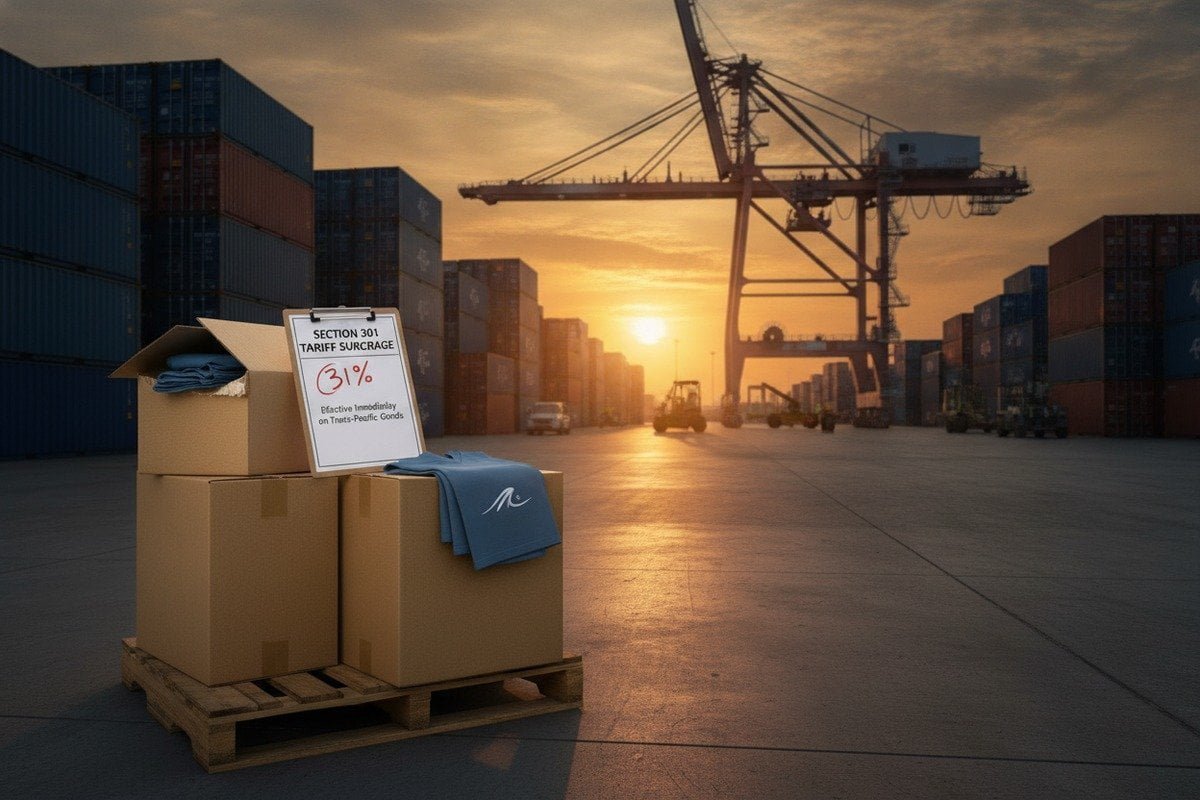
Yes. As of 2025, cotton t-shirts from China are subject to additional tariffs beyond the base MFN duty. These include Section 301 tariffs and IEEPA surcharges that can add roughly 31 percentage points, bringing the combined rate to approximately 47.7% of customs value. Rates change frequently, so verify before each shipment.
What Are Section 301 Tariffs?
Section 301 of the Trade Act of 1974 7 gives the U.S. President authority to impose tariffs on goods from countries engaged in unfair trade practices. Beginning in 2018, the U.S. imposed multiple rounds of additional tariffs on Chinese goods. Apparel, including cotton t-shirts, was added to the tariff lists in later rounds. The additional rate has been 7.5% or higher, depending on the list and any subsequent presidential modifications.
What Is the IEEPA Surcharge?
In 2025, a new layer appeared. Under the International Emergency Economic Powers Act (IEEPA) 8, additional duties were imposed on Chinese imports. For apparel, this surcharge stacks on top of both the MFN duty and any existing Section 301 tariff. The result is the combined rate of roughly 47.7% that importers now face.
How the Duties Stack
| Duty Layer | Approximate Rate | Authority |
|---|---|---|
| Base MFN duty (HTS 6109.10) | ~16.5% | Harmonized Tariff Schedule |
| Section 301 tariff (List 4A) | ~7.5% | Trade Act of 1974, Section 301 |
| IEEPA surcharge (2025) | ~23.7% | International Emergency Economic Powers Act |
| Total combined rate | ~47.7% | Stacked |
These rates are approximate and subject to change. The exact percentages depend on the specific HTS subheading and any executive orders or trade negotiations active at the time your goods enter the United States.
The De Minimis Exemption Is Gone for China
Before May 2, 2025, shipments valued under $800 could enter the U.S. duty-free under the de minimis threshold 9. That exemption has been eliminated for goods originating from China and Hong Kong. This means every cotton t-shirt shipment from China, no matter how small, now owes the full stacked duty. Small e-commerce sellers and sample orders are hit especially hard by this change.
Who Actually Pays These Tariffs?
A common misconception is that tariffs are "paid by China" or by the Chinese factory. They are not. The importer of record — the U.S. company or individual who brings the goods into the country — pays the duty to U.S. Customs and Border Protection at the time of entry. Our factory in Zhejiang does not pay U.S. import duties. The cost burden falls on the American buyer and is then passed along the supply chain to distributors, retailers, and ultimately end consumers.
How can I accurately calculate the total landed cost for my promotional t-shirt order?
We help our buyers build accurate cost models before production even starts. The factory price on the invoice is just one piece of the puzzle. If you skip the landed-cost calculation, your margins can vanish overnight.
To calculate total landed cost, add together the customs value of your goods, all applicable duties (base MFN plus Section 301 plus any IEEPA surcharges), freight and insurance charges, customs brokerage fees, merchandise processing fees, harbor maintenance fees, and any applicable state sales tax after importation. Duty is assessed on customs value, not the retail price.
What Is Customs Value?
Customs value is usually the transaction value — the price you actually paid or agreed to pay for the goods. Under most Incoterms 10 (like FOB), this includes the cost of the goods and any assists or packing charges, but not international freight. Under CIF terms, freight and insurance are included in the customs value. The distinction matters because duties are a percentage of customs value.
A Simple Landed-Cost Example
Let us walk through a real-world scenario. Say you order 5,000 cotton promotional t-shirts at $2.00 each, FOB Shanghai.
| Cost Component | Calculation | Amount |
|---|---|---|
| Product cost (FOB) | 5,000 × $2.00 | $10,000 |
| Ocean freight + insurance | Estimate | $1,200 |
| Customs value (FOB basis) | Product cost | $10,000 |
| Combined duty at 47.7% | $10,000 × 47.7% | $4,770 |
| Merchandise Processing Fee (MPF) | ~0.3464% of value (min $31.67, max $614.35) | ~$34.64 |
| Harbor Maintenance Fee (HMF) | ~0.125% of value | ~$12.50 |
| Customs brokerage fee | Flat fee, varies by broker | ~$150 |
| Total landed cost | $16,167.14 | |
| Landed cost per shirt | $16,167.14 ÷ 5,000 | $3.23 |
In this example, a $2.00 factory-price t-shirt becomes a $3.23 landed-cost t-shirt before you add domestic shipping, warehousing, screen printing, or any profit margin. The duty alone accounts for almost half the total landed cost.
Why This Matters for Promotional Buyers
Promotional t-shirts are low-margin goods. They are bought in bulk for giveaways, trade shows, employee programs, and branded merchandise. When your per-unit cost jumps by 60% due to duties alone, the math changes fast. A marketing agency budgeting $2.50 per shirt for an event giveaway suddenly needs $3.50 or more — and that is before decoration.
How Duty Changes Ripple Through Retail Pricing
One published example shows a basic cotton tee with a $15 retail price increasing to $22.18 once the full tariff burden is factored in. That is a 48% price increase at the consumer level. For promotional distributors who compete on price, this kind of jump can make China-sourced goods uncompetitive compared to alternatives from countries with lower or no additional tariffs.
Tips for an Accurate Cost Model
- Confirm the Incoterm with your supplier. FOB and CIF produce different customs values.
- Get a freight quote before you calculate duty, especially for LCL (less-than-container-load) shipments where per-unit freight is higher.
- Ask your customs broker for a duty estimate based on the exact HTS code and current tariff schedule.
- Build in a buffer. Tariff rates can change between the time you place an order and the time your goods arrive at port. A 5% contingency buffer is prudent.
What steps can I take to minimize import taxes and avoid customs delays?
Over the years, we have watched our U.S. partners adopt a range of strategies to manage rising duty costs. Some are straightforward. Others require more planning. All of them start with good information.
To minimize import taxes, verify your HTS classification for accuracy, work with a licensed customs broker, explore sourcing from countries with lower tariff exposure, negotiate better FOB pricing to reduce customs value, consolidate shipments for freight efficiency, and monitor U.S. trade policy changes continuously so you can adjust orders before new tariffs take effect.

Get the Classification Right the First Time
Misclassification is the fastest way to either overpay or face a penalty. If your cotton t-shirt contains 5% spandex, it may still classify under 6109.10 — but if the blend shifts to 55% polyester, you are in a different tariff universe. We always provide detailed fiber content and construction specs on our packing lists so your broker can classify with confidence.
Work With a Licensed Customs Broker
A good broker does more than file paperwork. They track tariff changes, flag classification issues, and can help you apply for any available duty relief programs. For promotional apparel importers dealing with frequent shipments, a broker relationship is not optional — it is essential.
Consider Sourcing Diversification
Some of our buyers have started splitting orders between China and other manufacturing countries like Vietnam, Bangladesh, India, or Turkey. These countries may not be subject to Section 301 tariffs or IEEPA surcharges, which can significantly lower the combined duty rate. However, diversification comes with trade-offs in quality consistency, lead times, and minimum order quantities. We help our clients evaluate those trade-offs honestly.
Negotiate FOB Pricing Strategically
Since duty is calculated on customs value, a lower FOB price means lower duty in absolute dollar terms. This does not mean pressuring your supplier to cut corners — it means working together on fabric selection, trim specifications, and order volumes to find a price point that keeps quality intact while reducing the dutiable value. Bulk orders almost always unlock better per-unit pricing, which lowers the duty per shirt.
Monitor Policy Changes in Real Time
The U.S. tariff landscape for Chinese goods has changed multiple times in the past few years. Rates have gone up, exemptions have disappeared, and new surcharges have appeared. Staying current is not a luxury — it is a cost-management necessity. Subscribe to updates from the USTR, CBP, and trade publications. Set calendar reminders to check rates before placing each order.
Keep Documentation Clean
Customs delays often result from incomplete or inconsistent paperwork. Make sure your commercial invoice, packing list, bill of lading, and country-of-origin certificate all match. Discrepancies between documents trigger inspections and holds. From our factory, we double-check every document set before shipment, but the importer should review everything independently as well.
Plan for the Long Term
If your business depends on Chinese-made promotional apparel, build tariff volatility into your business model. Set retail prices that can absorb moderate duty increases. Maintain relationships with suppliers in multiple countries. And always keep a few months of inventory buffer so a sudden policy change does not leave you unable to fulfill orders.
Conclusion
Importing cotton promotional t-shirts from China means navigating stacked duties, shifting trade policies, and detailed classification rules. Accurate HTS coding, current tariff verification, and a solid landed-cost model are the keys to protecting your margins and keeping your pricing competitive.
Footnotes
1. Direct link to the official HTS search tool. ↩︎
2. Explains a formal process for customs classification certainty. ↩︎
3. Official government agency responsible for customs. ↩︎
4. Clarifies who is legally responsible for import duties. ↩︎
5. Provides official classification for cotton t-shirts. ↩︎
6. Official source for HTS codes and duty rates. ↩︎
7. Provides background on the legal basis for Section 301 tariffs. ↩︎
8. Official text of the International Emergency Economic Powers Act from GovInfo, a government source. ↩︎
9. Defines a key customs exemption limit, especially its recent changes. ↩︎
10. Explains international trade terms for shipping and costs. ↩︎



Discussion
0 Comments
No comments yet. Be the first to share your thoughts!
Leave a Comment