


Every year, our production line ships thousands of cotton promotional tees to brand owners across Europe and the US Global Organic Textile Standard 1. Yet we consistently hear the same worry from first-time buyers: "How do I know this supplier is actually reliable?" It is a fair question. The promotional apparel market is crowded with polished websites, bold claims of "premium cotton," and rock-bottom quotes that look too good to refuse. The problem is that price alone tells you almost nothing about what will arrive at your warehouse eight weeks later. Shrinkage, fading prints, late shipments, and unresponsive service can turn a bargain into an expensive headache.
Procurement novices should evaluate cotton promotional T-shirt suppliers by combining product sample testing, factory verification, communication assessment, and quality-control policy review. Reliability is not one signal — it is a pattern of evidence built through samples, documentation, references, and a small trial order before any large commitment.
Below, we break this evaluation into four practical steps. Each section gives you clear actions, tables you can use as checklists, and the red flags that should make you pause. Let us walk through them one at a time.
How do I verify the actual fabric quality and weight of my cotton T-shirt samples?
When we prepare sample shipments at our facility in Zhejiang, we always include a full spec sheet with GSM 2, yarn type, and cotton composition. But not every supplier does this. If you receive a sample without clear fabric data, you are already at a disadvantage — and that gap can cost you real money once a bulk order lands.
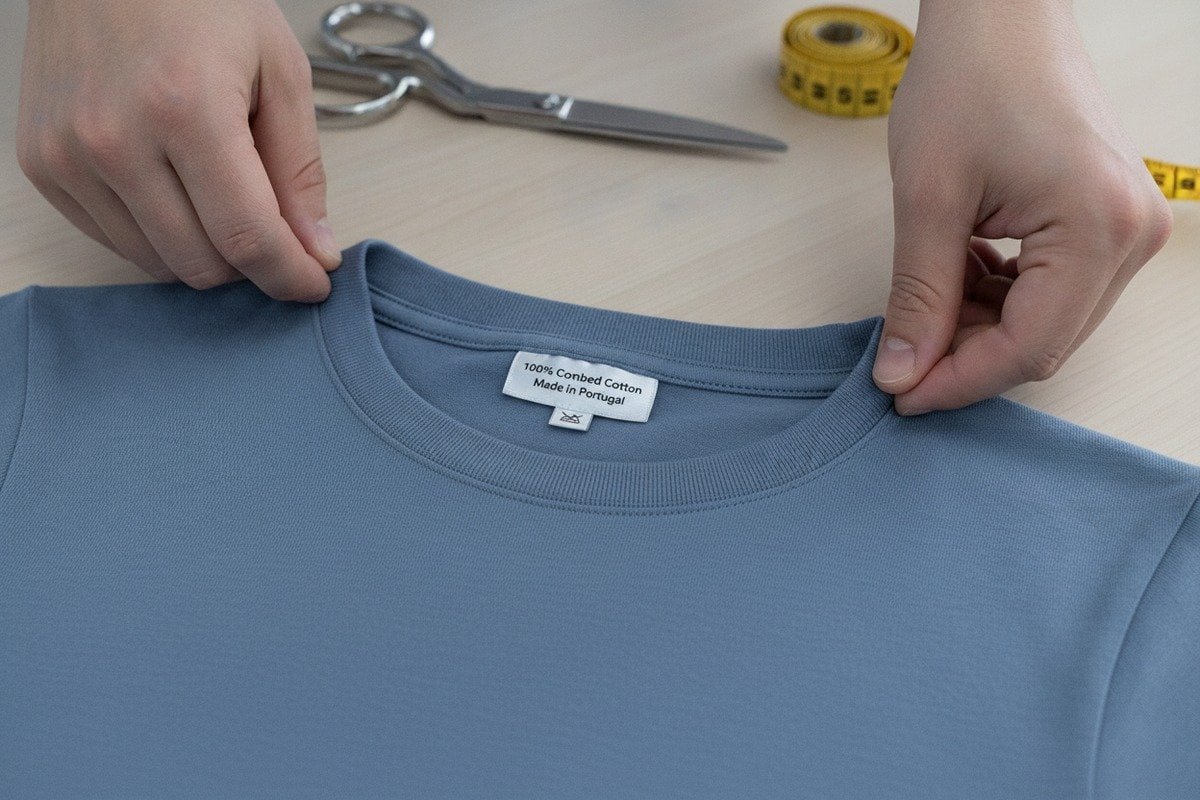
Verify fabric quality by checking the cotton composition label, measuring GSM with a fabric scale, washing the sample at least three times to test shrinkage and colorfastness, and inspecting seam strength, collar shape retention, and overall softness against your project requirements.
Why GSM Matters More Than You Think
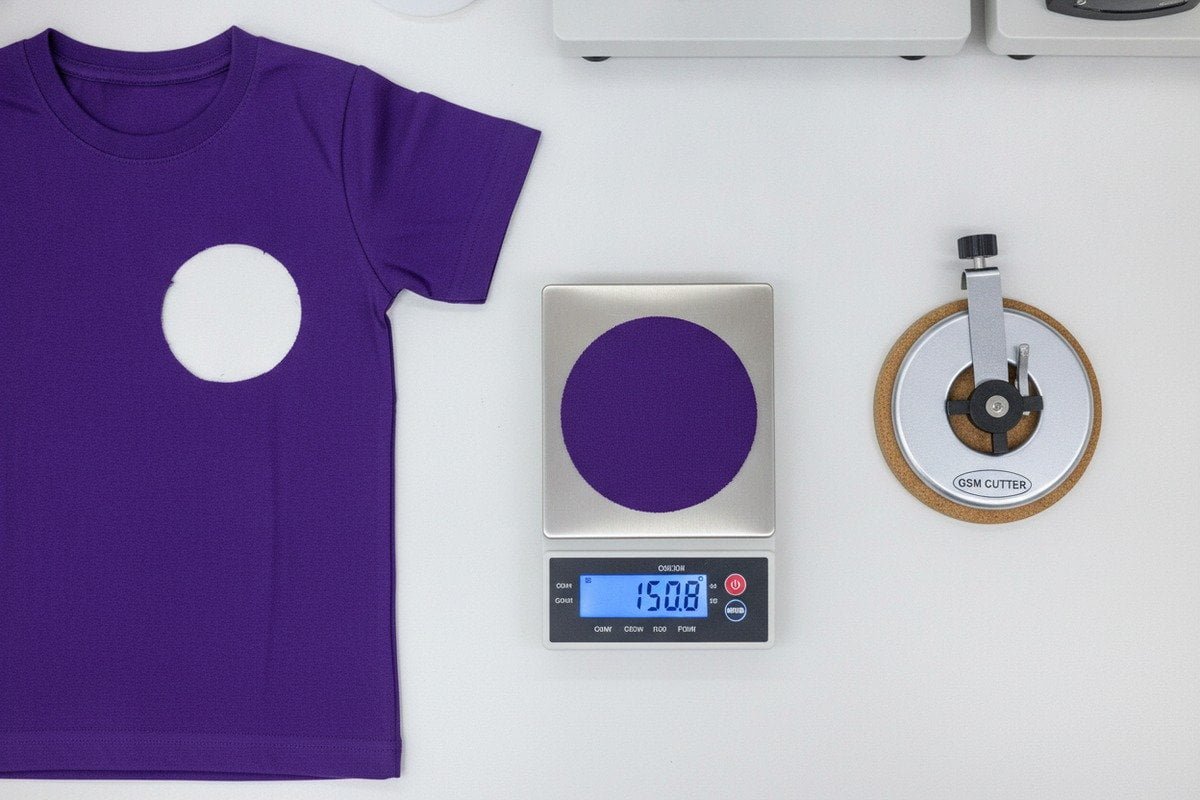
GSM stands for grams per square meter. It is the single most objective measure of fabric weight and density. A lightweight promotional tee usually sits between 130–160 GSM. A mid-weight tee — the kind that feels substantial without being heavy — runs 160–200 GSM. Anything above 200 GSM enters premium territory. When a supplier says "high-quality cotton" but refuses to confirm the GSM, treat it as a warning sign.
You can verify GSM yourself. Cut a 10 cm × 10 cm square from the sample. Weigh it on a kitchen scale or postal scale accurate to 1 gram. Multiply the result by 100. That gives you the GSM. If the number is more than 5–8% off from what the supplier quoted, ask why.
The Wash Test Is Non-Negotiable
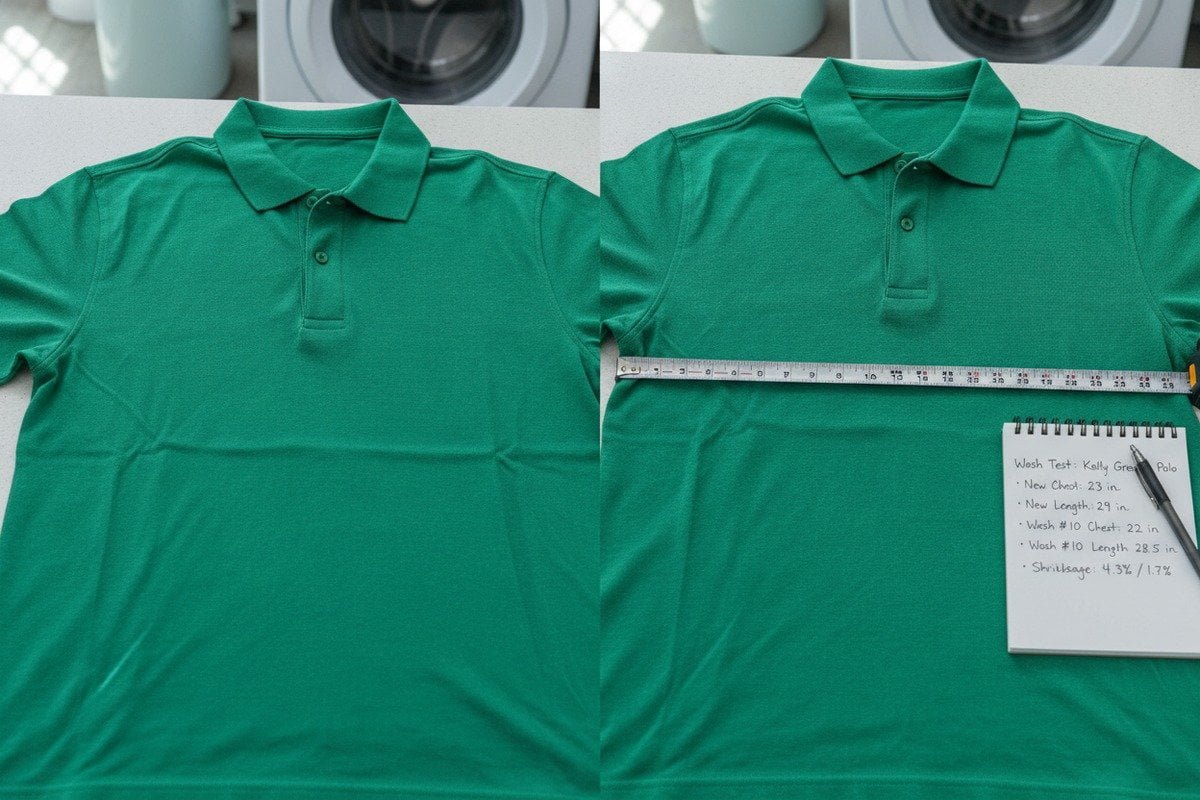
100% cotton can shrink 5–10% after washing. This is a well-documented property of natural fiber 3. Run at least three home-wash cycles on your sample. Measure the shirt before the first wash and after the third. Record the length, chest width, and sleeve length. If the shrinkage exceeds the supplier's stated tolerance — or if the supplier never mentioned a tolerance — you have a data point that matters.
Also check colorfastness 4. Wash the sample with a white cloth. If color bleeds heavily, the dyeing process is substandard. For promotional tees that carry a client's logo, faded or bleeding color destroys brand perception fast.
Stitching and Seam Strength
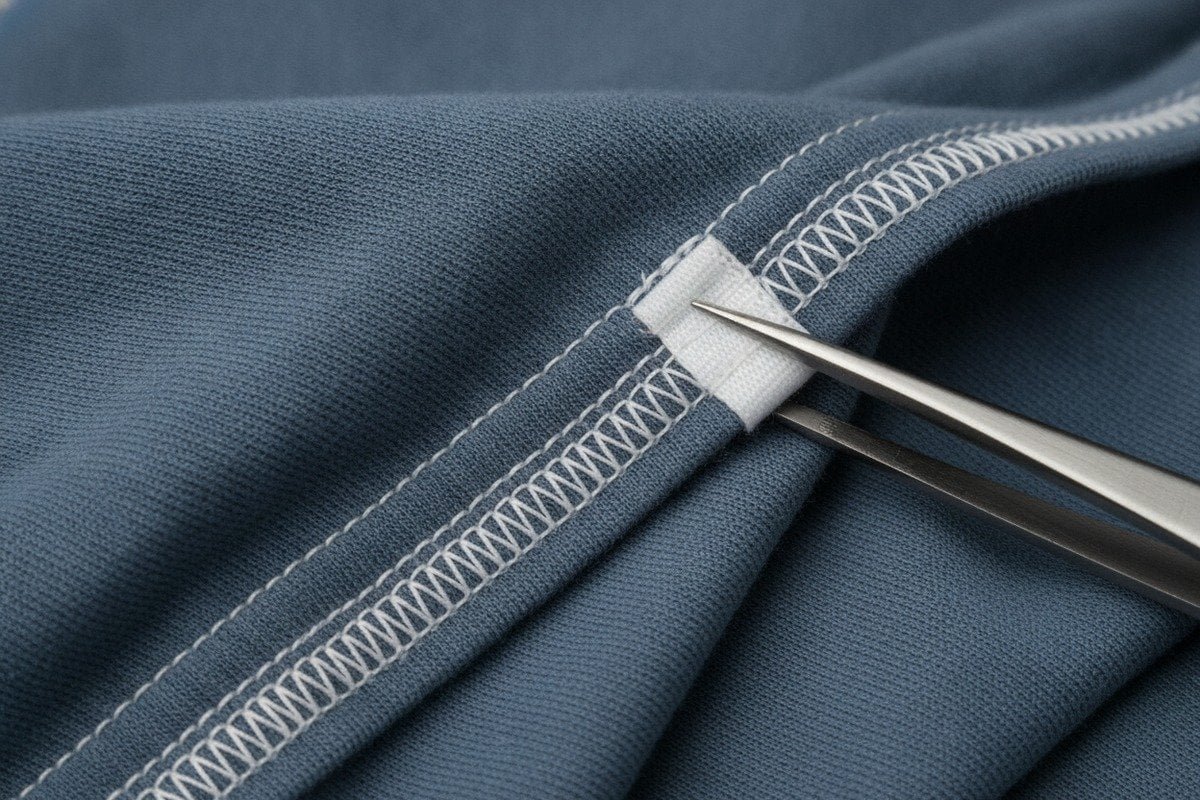
Turn the shirt inside out. Look at the side seams, shoulder seams, and hem. Are the stitches even? Is the thread count consistent? Pull gently on the seams. A well-made promotional tee uses a minimum of 8–10 stitches per inch 5 on side seams. Fewer stitches mean weaker seams and a shorter product life.
Fabric Quality Quick-Check Table
| Check | What to Look For | Red Flag |
|---|---|---|
| Cotton composition | 100% cotton or stated blend on label | No label or vague "cotton-feel" description |
| GSM | Matches quoted spec within ±5% | Supplier refuses to state GSM |
| Shrinkage | Under 5% after 3 washes | Over 8% shrinkage, no shrinkage data given |
| Colorfastness | Minimal bleed on white cloth | Heavy color transfer after first wash |
| Stitching | 8–10+ stitches per inch, even and tight | Loose threads, uneven stitch lines |
| Collar retention | Holds shape after washing | Collar stretches or curls after one wash |
Comparing Cotton Types
Not all cotton is equal. The yarn type 6, staple length, and finishing process all affect hand-feel, durability, and cost.
| Cotton Type | Typical Use | Cost vs. Standard Cotton | Key Benefit |
|---|---|---|---|
| Carded cotton | Budget promotional tees | Baseline | Low cost, acceptable softness |
| Combed cotton | Mid-range promotional tees | +10–15% | Smoother, fewer short fibers |
| Ring-spun cotton 7 | Premium promotional tees | +20–30% | Softer, stronger, better print surface |
| Organic cotton (GOTS) | Eco-branded campaigns | +25–40% | Certified sustainable sourcing |
When you receive a sample from a supplier like us — say, a vibrant kelly green polo or a muted slate blue relaxed-fit tee — match the hand-feel and weight against these benchmarks. If the supplier claims ring-spun cotton but the fabric feels rough and loosely woven, the claim does not hold up.
What steps should I take to vet a Chinese supplier's factory and production capacity?
Our team of three runs lean, but we coordinate with partner factories across Zhejiang to fulfill orders ranging from 300 to 10,000 pieces. When buyers ask us to prove capacity, we welcome it — because legitimate suppliers have nothing to hide. The ones who dodge these questions are the ones you should worry about.
Vet a Chinese supplier by confirming their business registration, requesting a virtual or in-person factory tour, asking for production photos with timestamps, checking third-party platform ratings, verifying certifications directly with issuing bodies, and requesting references from at least two existing buyers in your market.
Manufacturer vs. Trading Company vs. Reseller
The first thing to determine is what kind of entity you are dealing with. A manufacturer owns the production line. A trading company sources from multiple factories and adds a margin. A reseller might not even see the product. Each model has trade-offs.
Direct manufacturers often offer lower unit costs and more customization control. Trading companies can offer wider product ranges and sometimes better English communication. Neither is inherently bad — but you need to know which one you are working with so you can set expectations correctly.
Ask directly: "Do you own the factory where my T-shirts will be produced?" If the answer is vague, follow up with: "Can you share photos of the production floor with today's date written on a whiteboard?" This simple request filters out many intermediaries who cannot produce such evidence.
Verification Checklist
| Verification Step | How to Do It | Why It Matters |
|---|---|---|
| Business license check | Request a copy of the Chinese business license; cross-check on National Enterprise Credit Information System 9 (NECIPS) | Confirms legal entity and registration date |
| Factory tour | Request a live video call walkthrough or hire a third-party inspection agent | Shows real production environment and capacity |
| Production photos | Ask for timestamped photos of your specific order in progress | Proves the supplier actually manufactures, not just resells |
| Platform ratings | Check Alibaba Trade Assurance score, Made-in-China reviews, or Global Sources profile | Aggregated buyer feedback reveals patterns |
| Certifications | Request certificate copies; verify certificate numbers with issuing bodies (e.g., OEKO-TEX, GOTS, ISO) | Prevents reliance on fake or expired certificates |
| Buyer references | Ask for contact details of 2–3 existing clients, ideally in your region | First-hand experience from peers is hard to fake |
Understanding Production Capacity and Lead Times
Ask about monthly output in pieces, not just vague terms like "large capacity." A factory producing 20,000 T-shirts per month has very different lead times than one producing 5,000. Match their capacity to your order size. If you need 3,000 printed tees in four weeks, and their monthly output is only 5,000 across all clients, your order could easily slip.
Also ask about peak seasons. In our experience shipping to Europe and the US, March through June is the busiest period for promotional apparel. Factories get backed up. If your campaign launches in summer, place your order early — or confirm the supplier has reserved capacity for you.
Start with a Shortlist
A practical workflow is to identify 5–8 potential suppliers, narrow them down to 3 based on initial communication and quoted specs, order samples from all 3, and then run a pilot order of under 500 pieces with the top candidate. This approach limits your financial exposure while giving you real production data.
For example, you might be sourcing a classic deep royal purple kids' tee for a school promotion. Get samples from three suppliers. Compare the color accuracy, the fabric hand-feel, the print placement, and the packaging. The differences will be obvious — and they will tell you more than any sales pitch.
How can I identify potential communication red flags before placing my first bulk order?
When we onboard a new buyer — whether they find us through Google, Alibaba, or a cold email — we make it a point to respond within 12 hours with specific answers, not generic templates. That discipline is intentional. In our line of work, how a supplier communicates before an order is a strong predictor of how they will perform after you have paid.
Identify communication red flags by tracking response times, checking whether answers address your specific questions, noting if the supplier avoids technical details, watching for pressure to pay quickly, and confirming that all agreements are documented in writing rather than verbal promises alone.
Speed Alone Is Not Enough
A fast reply that says "Yes, we can do everything" is not a good sign. What you want is a fast reply that addresses your exact question. If you asked about GSM and yarn type, the response should include numbers and terms — not "We use best quality cotton, don't worry." Vague reassurance is a red flag in any sourcing relationship.
The Technical Question Test
Before placing an order, ask at least two or three technical questions. For example:
- "What is the GSM of this T-shirt in the 180 GSM range? Is it carded or combed cotton?"
- "What is the shrinkage rate after three washes at 40°C?"
- "Can you confirm the Pantone code you will use for this kelly green polo?"
If the supplier answers clearly and quickly, that is a positive signal. If they deflect, generalize, or take days to respond, you are dealing with someone who either does not know their own product or does not prioritize your order.
Documented Communication Channels
Agreements made over WhatsApp or WeChat are fine for speed — many of our European buyers prefer WhatsApp. But every important detail — pricing, delivery dates, quality specs, print files, payment terms — should also exist in email or a formal order confirmation document. If a dispute arises later, you need a paper trail. Suppliers who resist putting things in writing are protecting themselves, not you.
Pressure Tactics
Be cautious of any supplier who pushes you to pay the full amount upfront, claims a price is only valid for 24 hours, or says production slots will disappear unless you commit immediately. Legitimate manufacturers understand that procurement takes time. A standard payment structure is 30% deposit and 70% before shipment, or via Trade Assurance on platforms like Alibaba. If someone demands 100% upfront with no escrow option, walk away.
What Good Communication Looks Like vs. What Does Not
Good communication is specific, timely, and documented. Bad communication is vague, slow, and verbal-only. Over time, these patterns compound. A supplier who is unclear about specs before an order will be unclear about defects after an order. Trust the pattern, not the promise.
One practical tip: send the same inquiry to all shortlisted suppliers at the same time. Compare the responses side by side. The differences in clarity, detail, and professionalism will become immediately obvious.
What are the best ways for me to assess a supplier's quality control and return policies?
We run a three-stage inspection process on our production runs — pre-production fabric check, in-line sewing audit, and final pre-shipment inspection. We know from experience that skipping any stage multiplies the chance of a defect reaching the buyer. But not every supplier operates this way, and many novices do not think to ask about QC until something goes wrong.
Assess a supplier's quality control by asking for their inspection process documentation, requesting photos or reports from previous orders, reviewing their written return and defect policy, confirming who pays for reshipping or reprinting defective goods, and placing a small trial order to test the entire fulfillment cycle firsthand.
What to Ask About QC Before You Order
Do not wait until you receive a defective shipment to learn about the supplier's QC process. Ask these questions upfront:
- At what stages do you inspect the product?
- What is your acceptable quality level 10 (AQL) for defects?
- Can you share a QC report from a recent order?
- Do you use third-party inspection services, or is all QC done in-house?
- What happens if a defect is found after shipment?
A supplier who can answer all five questions clearly and provide documentation is far ahead of one who says "We check everything, no problem."
Understanding AQL
AQL — Acceptable Quality Level — is the industry-standard framework for defect tolerance in bulk production. It does not mean zero defects. It means defects are kept within a statistically acceptable range. For promotional T-shirts, a typical AQL is 2.5 for major defects and 4.0 for minor defects. If a supplier has never heard of AQL, their QC process is likely informal at best.
Return and Defect Policies
This is where many novices get burned. A low price means nothing if the supplier refuses to take responsibility for defective goods. Before you order, get written answers to these questions:
- If more than X% of the order is defective, will you reprint or reship at no cost?
- Who pays return shipping on defective items?
- What is the claim window after delivery?
- Do you offer partial refunds or credits for minor defects?
QC and Policy Comparison Table
| QC / Policy Element | Strong Supplier | Weak Supplier |
|---|---|---|
| Inspection stages | 3 stages: fabric, in-line, final | "We check at the end" |
| AQL standard | States specific AQL levels | Has never mentioned AQL |
| QC reports | Provides photo-documented reports | No reports available |
| Third-party inspection | Welcomes or arranges it | Discourages or refuses |
| Defect responsibility | Clear written policy with thresholds | Vague verbal assurance |
| Return shipping cost | Supplier covers for confirmed defects | Buyer pays all return costs |
| Claim window | 14–30 days after delivery | No stated window |
The Trial Order as Your Best QC Tool
No amount of questioning replaces the data you get from a real order. Place a trial order of 200–500 pieces. When the shipment arrives, inspect it thoroughly. Check a random sample of at least 10% of the units. Measure dimensions, inspect prints, check seams, and wash a few pieces. Compare what you received to the sample you approved.
If the trial order matches the sample in quality, arrives on time, and the supplier communicates well throughout, you have strong evidence of reliability. If it does not, you have saved yourself from a much larger loss.
In our work with buyers like Simone — a procurement manager in Italy who wholesales football jerseys and promotional tees to local retailers — we have seen that the trial order is the single most effective risk-reduction step a novice can take. It turns assumptions into data.
Certifications as a Layer, Not a Guarantee
Certifications like OEKO-TEX, GOTS, BSCI, ISO 9001, WRAP, or SA8000 signal that a supplier has passed external audits. That matters. But certifications do not guarantee that every order will be flawless. Treat them as one layer of your evaluation. Verify certificate numbers directly with the issuing body. Check expiration dates. And remember: a certified factory can still have a bad production run. Your own inspection and trial order remain essential.
Conclusion
Evaluating a cotton promotional T-shirt supplier is not about finding one perfect signal. It is about accumulating evidence — through fabric testing, factory verification, communication tracking, QC review, and a real trial order. Start small, document everything, and let the data guide your decision.
Footnotes
1. Provides information on certified sustainable organic cotton. ↩︎
2. Defines a fundamental metric for fabric weight and density. ↩︎
3. Explains a key characteristic of natural fibers like cotton. ↩︎
4. Found a detailed guide on colorfastness testing methods and standards. ↩︎
5. Details a critical metric for garment seam strength and durability. ↩︎
6. Explains the importance of specifying yarn type in fabric data. ↩︎
7. Highlights the superior qualities and uses of ring-spun cotton. ↩︎
8. Explains key aspects of textile fabric quality evaluation. ↩︎
9. Official system for verifying business registration in China. ↩︎
10. Defines the industry standard for defect tolerance in manufacturing. ↩︎



Discussion
0 Comments
No comments yet. Be the first to share your thoughts!
Leave a Comment